Breeding Terms
IP- (in pouch) term referring to a joey in a females
pouch
ITP- (in the pouch) Term referring to a joey in a females pouch
OOP- (out of pouch) First day joey is completely out of pouch,
most breeders do not declare joeys out of pouch until they have detached
from the females nipple
General Breeding Information
Sexual maturity is reached at about 6 to 18
months in females and 4 to 12 months in males. There are a few signs
that a male has hit maturity, one being the presence of scent glands on
the chest and forehead. You may also notice your males "sack drop". With
females, there are no physical signs of maturity, however it is best to
wait between 8-12 months to breed her. Breeding a female too young can
result in rejected or cannibalized joeys. Most female sugar gliders will
continue to breed until they are 5-8 years old. Rarely females may breed
longer depending on physical and emotional health, diet, and overall
desire to be a mother. Most males will continue to breed throughout
their lifespan. In captivity sugar gliders will breed year round. It is
important to note that sugar gliders breed on their own terms. Some
sugar gliders will be together for years and never breed, while others
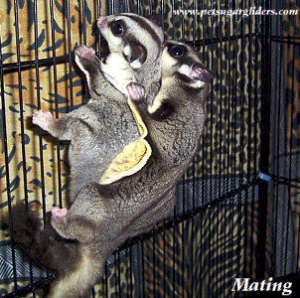
will breed upon reaching maturity. A females cycle is 29 days. Ovulation
will generally occur within two days of estrous. Please note that male
sugar gliders have a bifurcated penis, and females have 2 separate
vaginae and cervixes and a divided uterus. This makes it possible for
sugar gliders to have joeys at different stages of development. DO NOT
OPEN THE FEMALE'S POUCH. Sugar gliders are born with under developed
jaws. If the joey comes off the nipple it will likely die as it won't be
able to open it's jaw to reattach.
Click photo to enlarge
 
The Birth
Gestation will occur for approximately 16 days. Most gliders will give
birth during daylight hours in the morning-noon. The mother will begin
by licking a wet path from her cloaca to her pouch. By matting down the
fur she makes it easier for the joey to find it's way to her pouch, and
to keep the baby from getting tangled in her fur. 1 to 2 joeys are most
common, however they can have up to 4 joeys at a time. Once in her
pouch, the newborn joey will find and attach to a nipple. Once the joey
has attached to the nipple, it will begin to swell inside the baby's
mouth. It's jaw will remain locked on the nipple for the next 8-9 weeks.
Should the joey come off prematurely, it will die. The baby's jaw is not
developed enough to open and latch back on the nipple. The entire
birthing process will take only about 5 minutes. Very few are lucky
enough to see a sugar glider give birth.
If you did not see the birth, there are a few signs that she
has a joey on the way, such as:
- You may see the trail she licked from the cloaca to her pouch
(sometimes called a "licky trail")
- The female may clean her pouch more than usual
- She may become a bit more "pouch protective" of her nest or
sleeping quarters
- Some females can become grumpy or irritable
- Pouch could be a little puffy or fuller looking
Stats
- Size- weigh 0.2 g and about 5 mm in length.
Similar in size to a grain of rice
- Fur- None, pink
- Development- Blind, eyes very under developed,
Ears closed and under developed, numbs for limbs
- Mobility- Little, crawls into pouch
Click photo to enlarge
   
 
up to 1 week in pouch
The joey does not do a lot of growing in size
this stage. Don't worry if you not see the joey at this time, as the
mother can easily hide the joey in the back of her pouch. If you have a
bonded or tame glider it is possible to gently pick the mother up and
softly touch her pouch to confirm there is a joey(s). Do not panic if
you seen the birth, and do not feel the baby. The mother can still
easily hide the joey in the back of her pouch. I would not try this with
a glider that is not hand tame, as it would cause too much stress. DO
NOT OPEN HER POUCH, if the joey comes off the nipple at this stage it
will die. It won't be able to reattach, and hand feeding at this stage
is not possible. It is important to note that protein is related to milk
production, both in quality and quantity. Be sure to increase the
protein in the diet of the mother at this time.
Stats
- Size- Similar in size to a green pea.
- Fur- None, pink
- Development- Ears remain closed, eyes closed,
jaw under developed
- Mobility- Little
up to 2 weeks in pouch
It may be possible to see a dark spot or small lump depending on
the mother and position of the joey. However, the mother can still hide
her little joey fairly easily in the back of her pouch. As the joey
becomes larger, it becomes more possible to gently feel for the joey if
the mother is tame and bonded. As exciting as this time is, do not check
the female everyday for babies, as this can cause unnecessary stress and
ultimately lead to rejection of the joeys.
Stats
- Size- Doubled since birth, Similar in size to a
small shelled peanut
- Fur- None, pink
- Development- Ears and eyes remain closed, jaw
under developed, feet are beginning to become more
defined, tail is starting to form
- Mobility- Little
up to 4 weeks in pouch
The mother can no longer hide the joey, and a lump is visible by
looking at mom. If there are twins in pouch, you will see a lump on each
side of her pouch. Should there be only one baby, the pouch will appear
to be lopsided. If you do not see a lump by now, it is possible that the
mother has rejected or cannibalized the joey. There are several reasons
this will happen such as diet deficiency, unknown defect or illness with
the joey, stress, too young to breed, or if it was her first time, she
may not have known how to care for the joey.
Stats
- Size- Similar in size to a grape.
- Fur- None, pink
- Development- Head and Eyes grow larger, Ears are
still fused to the head, as well as eyes being
closed. Toes starting to form, tail not quite as
long as the joeys body, jaw still locked
- Mobility- slight movements
Click photo to enlarge

up to 7 weeks in pouch
The mother glider is quite large now, and you
would be amazed how active she can be. The baby can be seen through the
pouch as the skin is fairly thin and transparent. On occasion you may
get to see a little tail or foot slip through the pouch opening.
Although sugar gliders are arboreal, and like to be up high, you may
want to consider moving their sleeping area (pouch or nest box) down.
This way when the joey comes out of pouch and if happens to wander, it
is less likely to become injured.
Stats
- Size- At the beginning of this stage joey will
be Similar in size and shape to a peanut with its
shell and will grow quite rapidly.
- Fur- pink, dark sections can be seen where black
hair will grow in, Joey has a wet or shiny
appearance
- Development- Tail as long as joeys body, nails
and whiskers are starting to grow, ears still fused,
eyes become larger, remain closed, and have a layer
of skin over them, eyelids start to develop, nose
appears disproportion to it's head, jaw remains
locked
- Mobility- Movements can be seen from outside the
pouch
Click photo to enlarge
  
up to 9 weeks in pouch
Sometime between 8-9 weeks in pouch the joey
will be ready to survive the world outside mom's pouch. Most breeders
calculate the out of pouch date when the joey is detached from the
mothers teat, and no longer fits inside moms pouch. However opinions on
this do vary. Also note that twins may not come out of pouch (oop) the
same day, as it is possible for the mother to have joeys at different
stages of development. You will may hear the mother start to sing to her
joeys around this time. Each mother has a different song, and each song
will sound different. Once fully out of pouch, the new joey will begin
to nurse by sticking it's head into her pouch. The mother may leave the
joey alone in the nest with it's father to baby sit and keep the joey
warm. You may also see the babies hang under the mother's abdomen as she
moves about the cage. Some parents may leave the joey alone in the nest
while both parents are eating or playing. This is normal, and the
parents will return when the joey cries for them. Most sugar gliders are
great parents, but please watch and be prepared for rejection. It is
possible to start handling the joey but only a few minutes at a time
(2-5 minutes), and if possible where the mother glider can watch you.
Also now would be a good time to weigh the joey with a gram specific
scale. By watching the joey's weight, you will be able to identify
potential problems faster. Be sure to continue the high protein diet for
mom, as this will help with her milk production. Also, some breeders
will supplement the mothers diet with Woombaroo milk.
Stats
- Size- 12-18 grams (approximate average)
- Fur- Fine to moderately furred upon coming out
of pouch, the amount of fur on the joey will vary
greatly. The abdomen area, patagium (gliding
membrane), and legs may not be covered with fur and
remain pink, tail may be solid black and smooth as
the gray will fill in as the fur poofs out. Joey
loses that shiny appearance upon coming out of pouch
and detaching.
- Development- Ears are beginning to pop out, eyes
remain closed, you can now sex the joey, joey
becomes vocal
- Mobility- Stays in nest
Click photo to enlarge


up to 2 weeks out of pouch
Holding the joey about 10-15 minutes at a time
is recommended at this stage. The baby will most likely cry for mom
while holding it. You can calm the baby by keeping it warm, as it still
doesn't have much fur. Try placing the joey in your bra or cupping in
your hands. The mother glider may be nervous about you holding the joey
the first few times out of her site, especially if she is a first time
mother. Do not stress the mother out. If she is very concerned with you
holding her joey, start by walking away only for a minute, and put the
joey back. Slowly work up her trust. Speak softly to the baby so that it
becomes accustom to your voice. Shortly after the joey comes out of
pouch, the parents may decide to mate again. It is possible for her to
give birth to a new joey and while nursing one that is out of pouch.
2 week old joey crying
Right click and select "Save target as" (wav file)
Stats
- Size- (approximate average)
| 1
week oop |
12-22 grams |
| 2 weeks oop |
16-26 grams |
- Fur- Fur is starting to fill in on legs, and
will become increasingly thicker.
- Development- Joey becomes vocal, teeth are
starting to come through on the top jaw, bottom
teeth are little more than a lump, eyes will open
- Mobility- Stays in nest, may start to ride on
mom or dad's back
Click photo to enlarge
   

up to 4 weeks out of pouch
Around this time you will see your joey's personality
start to come through. Joeys can be held up to about a half hour at a
time. The baby can very active at this point depending on the glider, so
be prepared for a little jump or leap from your hands at any time.
4 week old joey barking for mom or sibling
Right click and select "Save target as" (wav file)
Stats
- Size- (approximate average)
| 3
week oop |
17-27 grams |
| 4 weeks oop |
23-33 grams |
- Fur- Joey is completely furred on it's
underside, the scrotum and pouch may not have fur
quite yet, tail will start to fluff out, body fur
will begin to thicken and become fuller
- Development- vocally starts to explore different
sounds it can make, ears are now up and consistently
moving picking up new sounds, teeth are now in, joey
may want to chew on nails, hair, and fingers
- Mobility- Starting to make small jumps or hops,
rides around on mom or dad's back
Click photo to enlarge
   
 
up to 6 weeks out of pouch
The joey will begin to come out of the pouch to
explore the cage with it's parents. It will also start to visit the food
stations and taste the different foods available to the parents. The
joey will mostly try the fruits and juices at first. Even though the
joey is starting to eat on its own, please understand that the joey is
not ready to be separated from it's parents. The joey is still nursing
off of it's mother regularly to get the required vitamins and nutrients
needed to be healthy. The joey is also still learning "how to be a
glider" from both parents by learning behaviors, sounds, and how to
react to people. The mother glider at this point is also still helping
and teaching the joey to use the bathroom.
Stats
- Size- (approximate average)
| 5
week oop |
30-40 grams |
| 6 weeks oop |
35-45 grams |
- Fur- Fuller, tail becomes more poofed out
- Development- Begins to try solid foods (mostly
fruit)
- Mobility- Explores cage with out riding on
parents, rides less on parents backs, some may try
to glide if given a chance
Click photo to enlarge

up to 8 weeks out of pouch
Around this time, the joey will be completely
weaned and ready to live on its own. Be sure before removing the joey
from it's parents that it is eating solid food, no longer suckling on
mom, and going to the bathroom on its own. Each joey will develop at its
own pace. Most gliders are ready at 8 weeks others may take a bit
longer. If you have a doubt, give it another week.
Stats
- Size- (approximate average)
| 7
week oop |
40-50 grams |
| 8 weeks oop |
45-60 grams |
- Fur- Fully furred, tail completely poofed out
- Development- Fully developed, eating solid
foods, going to the bathroom alone, able to live on
own
- Mobility- Fully mobile
Click photo to enlarge
   
  
|